

Off With the Head!
Why 20% of CEOs Now Face the Chopping Block
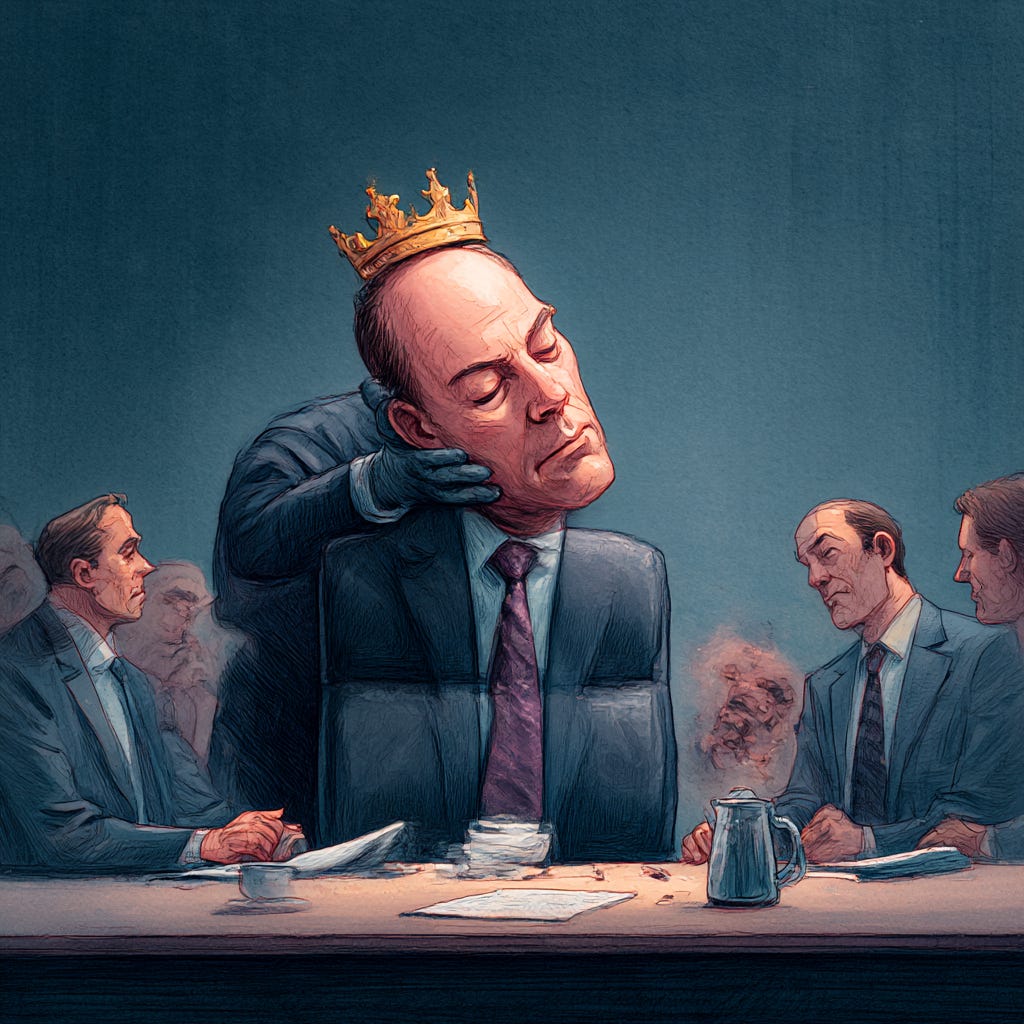
Five years ago, a CEO’s probability of forced termination hovered around 5%. By late 2024, Mark Thompson, chairman of the Chief Executive Alliance and author of “CEO Ready,” pegged that number at 20%. At the largest companies, he suggested, the risk felt closer to 40%.
That is a fourfold increase in firing probability within half a decade. Then 2025 made those numbers look quaint.
The 2025 Numbers:
1,235 CEOs left their posts through just the first half of 2025—a 12% spike from 2024 and the highest January-June total on record
222 CEO departures in January 2025 alone—a monthly record
247 CEO exits in February—nearly matching the all-time monthly peak
214 departures in April, a 70% surge from April 2024
18% of incoming CEOs in 2025 were named on an interim basis (versus 6% in 2024)—what Fortune called “the rise of the CEO gig economy”
Russell Reynolds Associates reports that 2024 saw 220 CEO departures globally among publicly traded companies tracked across 13 major indices—a six-year high. And 2025 is on pace to shatter that record by a wide margin.
Translation: If you are running a Fortune 500 company today, roughly one in five of your peers will be gone within the year. At major brands, the odds approach that of a coin flip.
The guillotine is in good working order, and it does not discriminate.
To understand why CEOs are falling at record rates, you need to understand two forces that converged in 2024: boards that think like activists and how scandals clear the way for action.
The Playbook: Why Boards Think Like Activists
The activist playbook has evolved from hostile takeovers to surgical strikes. As Ram Charan bluntly puts it, “The boss of a public board is not the investor, it is the activist shareholders.”
They no longer need controlling stakes. In 2024, Browning West replaced Gildan Activewear’s entire eight-member board in a proxy vote. The threat alone forces boards into preemptive action.
Michelle Seitz, former CEO of Russell Investments, advises CEOs to preemptively draft an activist letter against themselves—anticipating vulnerabilities and preparing responses before external attacks. Because boards are already beginning to think like activists.
The pressure for short-term results isn’t new. For decades, when quarterly targets were missed, the consequences flowed downward. RIFs. Hiring freezes. Delayed projects. The workforce absorbed the pain while executives adjusted strategy and tried again.
What changed? What’s new is who pays the price. The consequences are flowing upward.
When Stellantis missed targets, 15,000 workers were laid off—and then the CEO was fired. When Intel’s turnaround took too long, the workforce was cut 15%—and then the CEO was forced out. When Norfolk Southern faced a crisis, the company paid $1.7 billion—and then the CEO was terminated for an unrelated scandal the board would have overlooked in calmer times.
The same quarterly pressure that used to end careers on the factory floor now ends them in the C-suite. After decades of executives making the numbers work by cutting their workforce, boards are applying the same logic to the executives themselves.
But activist pressure is only half the equation. Boards have also recalculated what kinds of failures they’ll tolerate—and it is not limited to company performance.
Why Scandals Are More Damaging Than Accounting Fraud
Here is something that should terrify every CEO: You can survive a billion-dollar accounting scandal easier than getting caught on a kiss cam.
The research is clear. CEOs are 5x more likely to survive a billion-dollar fraud than a workplace romance, according to research by Aaron Hill, Ph.D., associate professor at the University of Florida’s Warrington College of Business.
Here is why boards think differently about these scandals: in financial fraud cases, CEOs have plausible deniability. They can blame rogue employees, systematic failures, or inherited problems. However, there’s zero leeway for personal misconduct. The CEO’s judgment becomes the only culprit.
Additionally, boards understand something rarely discussed openly: Financial scandals can be contained through process improvements and controls. Personal judgment failures signal an unfixable fundamental character flaw that no amount of training can remediate.
The decentralization of information distribution makes this particularly treacherous. Every moment is recorded. Every decision eventually becomes public. A previously private indiscretion can become global headlines within hours.
The new executive reality? Lead like transparency is inevitable. Because it is.
The Dawn of the Activist Board Member
What does winning look like when boards think like activists? Ask Alan Shaw.
Norfolk Southern: The Proxy Victory That Was Not
On May 9, 2024, Norfolk Southern CEO Alan Shaw stood before shareholders having just won a bruising proxy fight against activist investor Ancora Holdings. Shareholders voted 64% in favor of keeping Shaw. He retained control of the board. Ancora’s campaign to oust him over his handling of the catastrophic East Palestine, Ohio train derailment had failed.
Shaw had survived.
The East Palestine derailment—the environmental disaster in February 2023 that would cost Norfolk Southern $1.7 billion and subjected Shaw to Congressional hearings and NTSB criticism—seemed behind him.
True, Ancora had won three board seats despite losing the overall vote. But Shaw had the majority. He was safe. The man who promised to make Norfolk Southern the “gold standard for safety” collected $13.4 million in executive compensation—while communities dealt with toxic cleanup.
Four months later, he was fired.
Here is what Shaw missed: Ancora did not need to win the proxy fight. Securing those three board seats guaranteed vigilance. The minority directors exerted ongoing pressure, ensuring the board remained highly vigilant for any opportunity to remove Shaw. When Shaw’s personal conduct gave them an opening, the board pounced.
On September 8, 2024, Norfolk Southern announced it was investigating Shaw’s conduct. By September 11, he was terminated “for cause.” The reason: a consensual relationship with Chief Legal Officer Nabanita Nag that violated company policy.
Four months after “defeating” the proxy fight, Shaw was terminated, forfeiting an estimated severance of $9.6 million. After 30 years at Norfolk Southern, Shaw walked away with nothing but legal bills and reputational damage.
The man who promised to make Norfolk Southern the “gold standard for safety” collected top-tier pay while communities dealt with toxic cleanup—then got caught in a personal indiscretion that gave the board exactly the ammunition it needed.
Three months later, on December 1, 2024, became the watershed moment that proved no one was safe.
The Double Execution That Set the Template
A year ago, on December 1, 2024, two Fortune 500 CEOs received shockingly similar phone calls on a Sunday.
Carlos Tavares at Stellantis was given a weekend ultimatum. He resigned immediately with no replacement.
Pat Gelsinger at Intel was told to “retire or be removed” after a board meeting. He chose retirement.
Tavares and Gelsinger represent opposite scenarios. One cut too deep, the other overpromised. Tavares prioritized profit margins over market share and alienated his workforce. Gelsinger bet big on infrastructure with a five-year plan that would take a decade to pay off. Both got fired on the same day.
Stellantis: The Performance Pressure Play
Carlos Tavares spent his career building a reputation as a turnaround artist. He rescued PSA Peugeot from near-collapse, orchestrated the audacious merger with Fiat Chrysler to create Stellantis, and initially delivered stellar results. In 2020, Tavares set a bold strategy, Dare Forward 2030, to achieve 100% electric-vehicle sales in Europe and 50% in the U.S. by 2030.
In 2023, Stellantis posted its third consecutive year of record profits since its formation, with net profit growth of 11%—significantly higher than competitors like GM and Ford. These strong profits earned him €36.5 million in total compensation—making him the highest-paid automotive CEO globally.
Then Q3 2024 happened. The stock value decreased by 43% year-to-date, Q3 revenue plunged 27% overall, and 42% in North America, and 15,000 workers were laid off. The company lost nearly 50% of its market value after the October profit warning.
Former and current executives described Tavares’s approach to cost-cutting that funded Dare Forward 2030 as “arrogant” and “grueling to the point of excessiveness.” His relentless cost-cutting program, internally named “Darwin” in reference to survival of the fittest, squeezed suppliers, employees, and product quality. One source said, “If you do not know the market, you do not know the customers. You cannot make the right decisions.”
The United States—Stellantis’s prime cash generator—received insufficient investment in new models. Prices climbed while inventories ballooned on dealer lots. The company’s EV strategy floundered, with market share dropping from 5.3% to 3.5% as Chinese competitors surged ahead. Meanwhile, Tavares’ compensation packages made headlines even as the company laid off thousands of workers.
The steep executive compensation-versus-layoffs optics became untenable. The geographic disconnect between a Portuguese executive running an American-European company based in Amsterdam, while production moved to Brazil and Mexico, created optics that proved fatal.
Then the pressure campaign began. The United Auto Workers union ran a dedicated website calling for Tavares’s removal. UAW President Shawn Fain accused him of mismanaging the company and mistreating the workforce. The US Dealer Council sent a scathing letter blaming Tavares for pricing vehicles too high for the American market. Italian lawmakers questioned his decisions to move production to lower-cost countries while collecting massive pay packages.
Then came the board ultimatum. Over the weekend, senior independent director Henri de Castries delivered the message: “Different views have emerged.” Translation: You have until Sunday to resign, or we will remove you on Monday.
Tavares chose to resign: effective immediately, with no replacement. No “thank you" for your service” was given. Just a terse announcement that an interim executive committee would take over while they searched for a permanent replacement.
Intel: The Failed Turnaround Termination
The second termination that day was a different situation with the same ending. Pat Gelsinger’s story reads like a tragedy in three acts.
Act I: The Prodigy Returns
Gelsinger started at Intel at age 18 in 1979. He became the lead architect of the revolutionary 80486 processor. At 32, he was Intel’s youngest-ever vice president. In 2001, he became the company’s first chief technology officer, driving innovations in Wi-Fi, USB, and the Intel Core and Xeon chip lines.
After stints at EMC and VMware, where he served as CEO, Gelsinger returned to Intel in February 2021 as the company’s savior. Intel had lost its manufacturing edge to TSMC and Samsung. It had missed the mobile computing wave. It was about to miss the AI revolution entirely while Nvidia became the second-most-valuable company in the world.
Act II: The Ambitious Bet
Gelsinger had a plan: Spend $100 billion to rebuild Intel’s manufacturing dominance, transform the company into a foundry that makes chips for competitors like Apple, and restore America’s semiconductor self-sufficiency.
He positioned Intel as critical to US national security, winning multibillion-dollar Department of Defense contracts. He lobbied Congress to pass the CHIPS Act, ultimately securing $7.86 billion in federal grants—the largest direct subsidy from the program. He started construction on a $20 billion suite of new factories in Ohio.
He told investors his “five nodes in four years” roadmap would return Intel to manufacturing parity by 2025. He promised Intel’s 18A process technology would be competitive with TSMC’s best. He claimed Intel’s Gaudi AI chips could challenge Nvidia’s dominance.
Act III: The Board Loses Patience
Gelsinger’s five-year plan was, in fact, only three and a half years old. The 18A process he promised would not even come online until 2025. The Ohio fabs would not be operational for ten years. Every metric he set required more time than his narrative.
When Gelsinger met with Intel’s board to discuss progress on the turnaround, the Directors were not impressed. The company’s latest consumer processors received a lukewarm reception. Board member Lip-Bu Tan—the only director with semiconductor expertise—had quit months earlier over strategic disagreements, leaving the board unable to evaluate chip technology decisions competently.
Intel’s attempts to break into AI computing flopped. The company had just posted a $16.6 billion quarterly loss—its biggest in 56 years. The stock had fallen 60% from his start date. Revenue had shrunk to $54 billion in 2023, down a third from when he arrived.
The board delivered an ultimatum. Gelsinger chose to retire, effective December 1.
While unexpected, neither was irrational. Tavares EV strategy was a disaster, and he genuinely did misread the American market. Gelsinger genuinely overpromised on AI capabilities and underdelivered on manufacturing timelines. Both made mistakes that cost shareholders billions.
Today, optics matter as much as financial performance. Tavares and Gelsinger became the template for boards everywhere.
2025’s Victims
2025 turned the template into a production line. CEOs fell in months instead of years, for scandals rather than performance, often for reasons that would have been overlooked just months earlier.
Astronomer: The Kiss
Andy Byron built Astronomer into a $1 billion unicorn. He was the CEO taking his company to new heights in the data orchestration space.
Then came the Coldplay concert.
A kiss cam caught Byron with a woman—and she was not his wife. Within 24 hours, that two-second footage inspired 22,000 news articles.
No investigation was needed. The board moved with surgical precision. Within days, Byron was out as CEO.
Today, every moment is recorded, and every decision may eventually become public. Byron’s lesson: You never know when the camera will be pointed at you.
Nestlé: The 13-Month Double Execution
In August 2024, Nestlé fired CEO Mark Schneider for underperformance and weak sales growth. The world’s largest food company, known for glacial decision-making, moved with shocking speed.
They replaced Schneider with Laurent Freixe, a 25-year Nestlé veteran who knew the company intimately. Freixe lasted 13 months.
On September 2, 2025, Nestlé announced Freixe’s termination, without an exit package. The official reason: an undisclosed romantic relationship with a direct subordinate.
The board had zero tolerance remaining. Two CEOs in 13 months means any misstep—professional or personal—becomes grounds for immediate removal.
Evolve Bank: When “Restoring Confidence” Destroys It
In April 2024, Synapse Financial Technologies—a banking-as-a-service middleware platform—filed for bankruptcy. The filing locked 200,000+ customers out of their accounts across fintech apps like Yotta and Juno. Worse: In late 2023, Evolve Bank—one of Synapse’s four partner banks—realized Synapse’s ledgers were not accurate. Bankruptcy trustee Jelena McWilliams, former FDIC Chair, later concluded that between $65-95 million was unaccounted for.
Customers still cannot access their money as of December 2025.
In September 2024, Yotta filed a lawsuit alleging Evolve “failed in its most basic duty” and “conspired” with Synapse to improperly deduct $25 million from customer accounts. Yotta accused Evolve of prioritizing its largest client over smaller partners, creating a “Ponzi scheme.” Evolve blamed Synapse. Synapse blamed Evolve. Customers had no money and no answers.
The Federal Reserve issued a cease-and-desist order for compliance failures. Evolve faced multiple class-action lawsuits. The bank that had been profitable every year since 2003 began posting quarterly losses.
In August 2025, Evolve fired CEO Scott Stafford after 21 years and hired Bob Hartheimer with an explicit mandate: “Restore institutional confidence.”
Hartheimer’s resume was perfect. Twenty-five years in banking regulation. Deep relationships with regulators. The board presented Hartheimer as the adult in the room who would fix the Fed consent order, resolve the missing funds, and restore customer relationships.
He lasted exactly two months.
Two months later, FBI agents escorted Hartheimer out of Evolve’s Memphis headquarters in handcuffs on October 24, 2025. Federal charges: Sexual exploitation of a minor and distribution of obscene material.
The board terminated Hartheimer effective immediately. Media coverage shifted from “where is the money?” to “the CEO they hired to restore confidence is a predator.”
After the CEO hired to fix it was arrested for heinous crimes, the disaster continues for customers who cannot access their money. The bank still cannot explain where it went 20 months later.
The Evolve board will never face meaningful consequences, but its authority is restricted until regulators confirm compliance. The bank is privately held, so there is no stock price to crater. Customers have no recourse because their funds were held by Synapse, not directly by Evolve.
Five different CEOs, each terminated for a different reason. One pattern: boards have lost patience, tolerance, and loyalty. The question now is what you do about it.
What This Means for Your Company
Your CEO is operating under the same pressures as Fortune 500 leaders. Board patience is measured in quarters. Any vulnerability can serve as a basis for removal. Activists are researching your company, and your CEO’s resume will not protect them.
Compare tenures before termination:
Laurent Freixe (Nestlé): 13 months
Pat Gelsinger (Intel): 3.5 years with $100 billion turnaround plan
Carlos Tavares (Stellantis): 3.75 years despite merger success
Alan Shaw (Norfolk Southern): 30-year career, 2 years post-derailment
Scott Stafford (Evolve Bank): 21 years with partner blowup
The old normal: CEOs got 5-7 years to execute strategy. Boards provided runway for transformation. Patience for market conditions. Loyalty for tenure.
The new normal: 1-2 years maximum before termination conversations begin. Quarterly results determine survival. Boards will find any reason—performance, scandal, “different views”—to justify removal. A tenure that spans decades means nothing.
CEOs across sectors face different vulnerabilities. The CEO firing epidemic has direct implications for any growth company approaching late-stage scale especially:
For Fintechs: Banking-as-a-service models are under intense regulatory scrutiny post-Synapse. Compliance infrastructure must be bulletproof, not aspirational. Customer fund transparency is non-negotiable. “Institutional confidence” requires auditable systems, not confidence men.
For Legaltechs: Data security breaches now pose CEO-termination risk. Client confidentiality failures create immediate board vulnerability. Verified compliance is survival, not marketing copy.
For Martechs: Ad fraud and data privacy failures are existential threats. Customer data misuse provides activist ammunition. Brand safety incidents trigger board panic.
The New Survival Framework
Boards are paying CEOs more than ever while firing them faster than ever. In 2024, median CEO pay rose 14% while tenure expectations dropped to 1-2 years. Premium compensation with quarterly accountability is mathematically unsustainable.
High pay demands transformational performance. How long should they wait for it? In a world where short-term thinking is already eroding trust and value, this doesn’t seem sustainable.
So what happens next? One of three scenarios:
Boards lower compensation (unlikely - competitive pressure)
Boards extend timelines (unlikely - activist pressure)
CEO role fragments (likely - interim CEOs at 18% already signal this)
The rise of the CEO gig economy might be the future. Shorter tenures, project-based mandates, lower total comp but higher annual rates.
Until then, your board is one bad quarter from “different views” territory. These statements are no longer defenses:
❌ “We are building long-term value” (Board: Prove it.)
❌ “The strategy needs more time” (Board: We do not have time.)
❌ “Market conditions are challenging” (Board: Your competitors are thriving.)
❌ “We are investing in growth” (Board: We see spending, not returns.)
So what do you do while boards figure this out?
1. Write your own activist letter before someone else does.
Seitz’s advice to write your own activist letter makes perfect sense now. Boards already think like activists. They are scanning for vulnerabilities. They are preparing removal scenarios. They are one bad quarter away from losing patience.
If you self-critique before the board does, you control the narrative. If you anticipate vulnerabilities before they become ammunition, you can address them preemptively. If you treat every board meeting like a proxy fight, you stay ahead of the curve.
But even that may not be enough. Think about what an activist would say about your vulnerabilities quarterly:
Compensation versus performance?
Cost structure versus revenue growth?
Executive turnover patterns?
Customer complaints trending?
Address these issues with your board before they ask.
2. Build narratives based on reality.
Gelsinger is a warning against using unrealistic narratives to sell transformative strategies: Intel’s $100 billion foundry investment will take at least a decade to deliver results. Gelsinger was fired before his 18A process was expected to come online in 2025. The new CEO will inherit results without having built them, face the same impossible timelines, and likely get fired in turn.
Lesson: Infrastructure beats promises and PR. Verifiable progress beats aspirational goals.
Evolve hired someone to “restore institutional confidence” and created a disaster. Intel overpromised implementation timelines but failed to deliver. Norfolk Southern failed on safety and had a personal scandal.
3. Anticipate the “Why You” question.
Be ready to answer: “Why should we not replace you right now?” Show progress with leading indicators:
Transparent milestones for long-term strategies
Leading indicators of progress, not just final results
Scenario planning (”If X does not happen by Y, we pivot to Z”)
Self-imposed accountability before external pressure
Implement systems that force verification
Most importantly, demonstrate responsiveness to criticism. Prove you can self-correct.
4. Accept the new reality.
A 20% firing probability means one in five CEOs will be gone. As 2025 demonstrated:
Nobody’s job is safe
Nobody’s tenure matters
Nobody gets second chances
And nobody is coming to save you
The only person who can write your activist letter is you. Better write it before someone else does—because the board is already thinking like an activist, and they are one quarter away from losing patience.
CEOs face the guillotine more often than ever, and those who see it coming may be spared.